
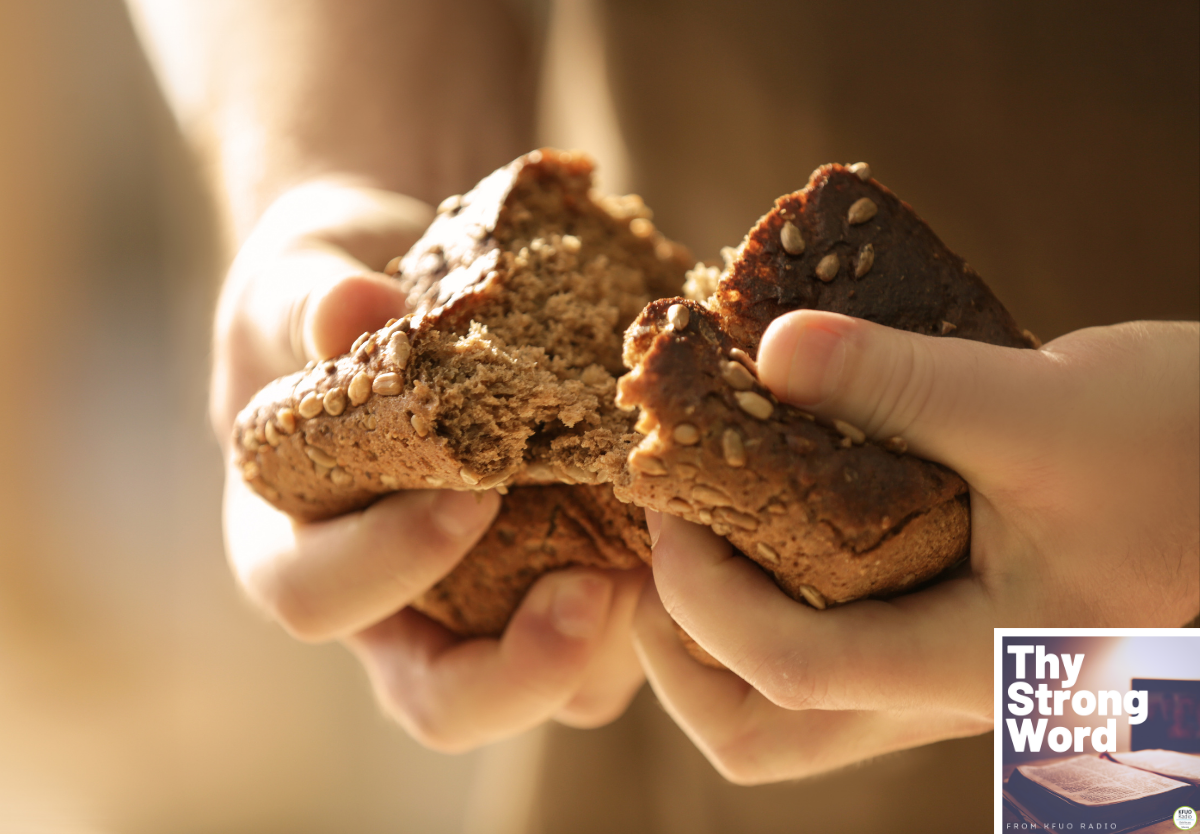
Meat from the market may be eaten with thanksgiving, but a meal at an idol’s altar is another matter. Why does the setting change what Christians may do? Paul answers by pointing to the Lord’s Supper, where the bread and cup give us participation in Christ’s body and blood. Fellowship at an altar means something, even when a person claims otherwise. As Paul distinguishes freedom from idolatry, he brings the question home to ordinary meals: how do we receive God’s gifts with gratitude while seeking our neighbor’s good?
The Rev. David Boisclair, senior pastor of Our Redeemer Lutheran Church in Overland, Missouri, joins guest host Andy Bates to study 1 Corinthians 10:14–33.
To learn more about Our Redeemer in Overland, visit ourredeemerstl.org.
What happens when Christians turn their pastors into rival teams, take one another to court, and leave their neighbors hungry at the Lord’s Supper? Corinth gives Paul plenty to write about. Questions about marriage, meat sacrificed to idols, spiritual gifts, and the resurrection bring the apostle into the daily life of a church struggling with pride and division. Through it all, he keeps bringing them back to Christ crucified and risen.
In 2 Corinthians, the strained relationship between Paul and the people he loves brings its own painful questions about forgiveness, faithful ministry, suffering, and weakness. These letters give us the treasure in jars of clay, the promise of resurrection, and the assurance that Christ’s grace is sufficient. Join Thy Strong Word as we study 1 and 2 Corinthians verse by verse and hear what God speaks to a troubled church He has called His own.
Thy Strong Word, hosted by Rev. Dr. Phil Booe, pastor of St. John Lutheran Church of Luverne, MN, reveals the light of our salvation in Christ through study of God’s Word, breaking our darkness with His redeeming light. Each weekday, two pastors fix our eyes on Jesus by considering Holy Scripture, verse by verse, in order to be strengthened in the Word and be equipped to faithfully serve in our daily vocations. Submit comments or questions to: thystrongword@kfuo.org.
Thy Strong Word is graciously underwritten by the Lutheran Heritage Foundation. Through the mission gifts of people like you, LHF translates, publishes, distributes and introduces books that are Bible-based, Christ-centered and Reformation-driven. Learn more at lhfmissions.org.
1 Corinthians 10:14-33
[14] Therefore, my beloved, flee from idolatry. [15] I speak as to sensible people; judge for yourselves what I say. [16] The cup of blessing that we bless, is it not a participation in the blood of Christ? The bread that we break, is it not a participation in the body of Christ? [17] Because there is one bread, we who are many are one body, for we all partake of the one bread. [18] Consider the people of Israel: are not those who eat the sacrifices participants in the altar? [19] What do I imply then? That food offered to idols is anything, or that an idol is anything? [20] No, I imply that what pagans sacrifice they offer to demons and not to God. I do not want you to be participants with demons. [21] You cannot drink the cup of the Lord and the cup of demons. You cannot partake of the table of the Lord and the table of demons. [22] Shall we provoke the Lord to jealousy? Are we stronger than he?
Do All to the Glory of God
[23] “All things are lawful,” but not all things are helpful. “All things are lawful,” but not all things build up. [24] Let no one seek his own good, but the good of his neighbor. [25] Eat whatever is sold in the meat market without raising any question on the ground of conscience. [26] For “the earth is the Lord’s, and the fullness thereof.” [27] If one of the unbelievers invites you to dinner and you are disposed to go, eat whatever is set before you without raising any question on the ground of conscience. [28] But if someone says to you, “This has been offered in sacrifice,” then do not eat it, for the sake of the one who informed you, and for the sake of conscience—[29] I do not mean your conscience, but his. For why should my liberty be determined by someone else’s conscience? [30] If I partake with thankfulness, why am I denounced because of that for which I give thanks?
[31] So, whether you eat or drink, or whatever you do, do all to the glory of God. [32] Give no offense to Jews or to Greeks or to the church of God, [33] just as I try to please everyone in everything I do, not seeking my own advantage, but that of many, that they may be saved.
Scripture quotations are from the ESV® Bible (The Holy Bible, English Standard Version®), © 2001 by Crossway, a publishing ministry of Good News Publishers. ESV Text Edition: 2025. The ESV text may not be quoted in any publication made available to the public by a Creative Commons license. The ESV may not be translated in whole or in part into any other language. Used by permission. All rights reserved.